
Holdem Tournament
Find over 265 Texas Hold 'em Tournaments groups with 78078 members near you and meet people in your local community who share your interests. Arkadium's Texas Hold'em: Tournament Tournament-style poker is the same as normal poker, but there are no buy-ins! Be the last one at the able to win this exciting tournament of skill, strategy and luck.
How to Set Up a No Limit Hold’em Tournament Home Game.
Brought to you by www.HoldemShirts.Net
Topics:
Pgs 1-2: The Basics (Hand Rankings and Basic Play)
Pgs 3-4: The Setup (Blinds, Chips, Seating, Payouts and Rules)
Pgs 5 : Extras (Rebuys, Add-ons and Chip Racing)
Hand Rankings:
Royal Flush
A royal flush is a straight flush that has a high card value of Ace (Ex: 10, J, Q, K, A). This is the highest hand in poker.
Straight Flush
A five-card sequence of the same suit (Ex: 4, 5, 6, 7, 8).
Four of a Kind
All four cards of the same rank (Ex: Q, Q, Q, Q). Four cards of the same value. AKA: Quads
Full House
Three of a kind combined with a pair (Ex: 3, 3, 3, K, K). Ties in a full house are broken by the three of a kind. If both hands share the same three of a kind, ties are broken by the higher pair.
Flush
Any five cards of the same suit, but not in sequence. If two people both have a flush in the same suit, the person with the highest card is the winner.
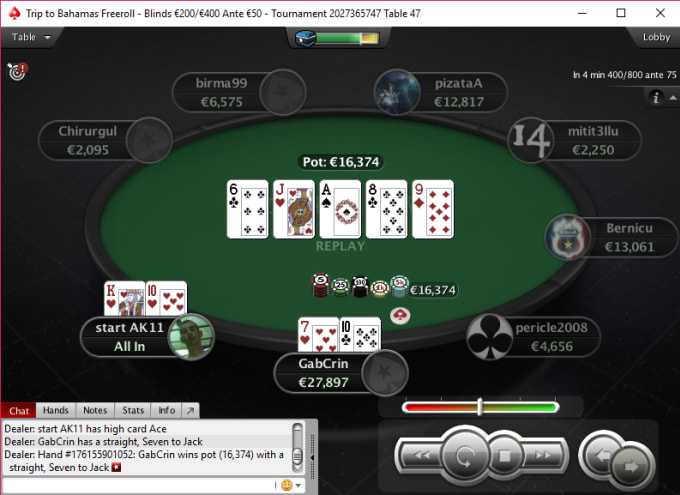
Straight
Five cards in sequence, comprised of mixed suits. Note: there is no wrap around (it doesn't work if you have K, A, 2, 3, 4). The straight that has the highest card is the winner. AKA: Run or Sequence
Three of a Kind
Three cards with the same value are considered three of a kind (Ex: 8, 8, 8). The three of a kind of the highest value is the winner. AKA: Trips, Triplets, or Trio
Two Pair
Two sets of equal value cards (Ex: 7, 7, Q, Q). The pair with the higher value is used to determine the winner of a tie.
One Pair
Two cards of equal rank (Ex: J, J).
High Card
If the hand has no other combination (see above), its worth is determined by the highest value card. If two players have the same high card, the tie is broken by the second highest card.
Basic Play of No Limit Texas Hold'em:
No Limit Texas Hold'em is played with a typical 52 card deck. Regular poker hand rankings apply. During any betting round, any player can go 'all in' (bet all the chips they have).
Hole Cards: The game begins with all the players receiving 2 cards face-down. Each player can only see his or her own cards. |
Betting Round 1. |
The Flop: The dealer lays 3 community cards face up on the center of the table. These are cards that the players can use with their own hand. |
Betting Round 2. |
The Turn: The dealer deals a fourth community card on the table. |
Betting Round 3. |
The River: The dealer puts one final community card on the table. |
Betting Round 4. |
The Showdown: The players show their hands, and the best hand (which is any 5-card combination of the player's cards and community cards) wins. |
Dealer Button:
The dealer button is a white disc-shaped object that moves clockwise around the table each hand, designating one player as sitting in the dealer position.
Blinds:
Blinds, like antes, are used to force action. The player to the left of the button has to post a 'small blind,' (a required bet that is smaller than the “big blind”). The player to the left of the small blind has to post a 'big blind' (a required bet which determines the lowest possible bet for future betting rounds.)
Note: For more on the basic play of No Limit Texas Hold’em, we recommend Celebrity Poker’s link: How to Play No Limit Hold'em.
Blinds and Starting Chips:
Blinds Schedule Starting Chips = $1000 or $1500 Round Length = 20 or 30 minutes 20min = 2.5-3.5 hours 30min = 3.5-5.5 hours | |||
Round | Ante | Small Blind | Big Blind |
1 | 10 | 15 | |
2 | 10 | 25 | |
3 | 25 | 50 | |
4 | 50 | 100 | |
5 | 75 | 150 | |
6 | 100 | 200 | |
7 | 150 | 300 | |
8 | 200 | 400 | |
9 | 300 | 600 | |
10 | 400 | 800 | |
11 | 500 | 1000 | |
12 | 600 | 1200 | |
13 | 700 | 1400 | |
14 | 800 | 1600 | |
15 | 900 | 1800 | |
16 | 1000 | 2000 | |
17 | 1200 | 2400 | |
Notes on Blinds:
This is a standard blind structure for a tournament consisting of 5-50 players. Each player should begin with $1000 in tournament chips (ex. $50 buy-in equals $1000 in tournament chips). If you would like the tournament to last longer, the starting number of chips can be increased to $1500. If you would like to speed up a tournament, antes can be added during the later rounds.
Hold'em Tournament Manager
Notes on Round Length:
The standard length of each round can be varied depending on the desired length of the tournament. As a rule of thumb, the tournament will usually end within one blind of the level of when the big blind equals the starting number of chips for each player. Another rule of thumb is that when the small + the big blind = 7-8% of the total number of chips in play, the tournament will end.
Chips for $1000 Tournament | ||
Color: | Value: | Starting Amounts: |
White: | $5 | 10 = $50 |
Red: | $25 | 10 = $250 |
Green: | $100 | 7 = $700 |
Blue: | $500 | |
As the tournament progresses, lower value chips should be raced off and higher value chips added (ex. $5 chips are taken out of play after round 2 and $500 chips should be inserted at or near round 8 when the $25 chips become unnecessary.)
Holdem Tournaments Payouts
Seating:
Each table should seat a maximum of 10 players (9 is preferred and 11 is possible if you must). The easiest method is to use decks of cards with one card for each seat at each table. For instance, if you have four tables of nine, use a deck consisting of the A-9 of diamonds (Table 1), the A-9 of hearts (Table 2), the A-9 of clubs (Table 3), and the A-9 of spades (Table 4). The ace is designated as the button, the 2 is seated as the small blind, the 3 is seated as the big blind, and so on around the table.
Note: As players are busted out, the tables may become uneven by more than one person. Multiple tables should remain balanced within one person. When tables are uneven wait until the end of the hand in progress at the larger table and then move the person in the upcoming BB to the short-handed table.
Payout Structures:
Standard Payout for 30-40 Person Tournament | |
1st | 35.0% |
2nd | 25.0% |
3rd | 12.5% |
4th | 10.0% |
5th | 7.5% |
6th | 5.0% |
7th | 5.0% |
Standard Payout for 8-10 Person Tournament | |
1st | 50% |
2nd | 35% |
3rd | 15% |
Note: Payouts can easily be modified to reward more or less players. It is also sometimes a nice idea to include a little something for the first person to bust out (maybe one of our “pinche rio” shirts?)
Basic Rules:
1. Cards and chips must be visible on the table at all times. Large chips out front.
2. Players have the right to request your chip count at any time.
3. If the dealer accidentally flips over a card, that card will become the first burn card. The player cannot keep it. If the dealer flips two cards while dealing, a misdeal is declared.
4. No string-bets. Announce that you are betting or raising before you do so. Any other action is considered a call.
5. The cards speak for themselves. Highest cards win.
6. No one ever gets to miss their big blind and no one ever has to pay the small blind twice in a row. If the small blind busts out, then the blinds post their money as usual and the button remains where it is. If the big blind busts out, the next big blind posts his money as usual and there is a dead small blind.
7. The Minimum bet/raise is equal to the BB. Any re-raise must be equal or greater than the previous raise.
8. When it gets down to heads up, the small blind is the button.
Basic Etiquette:
1. Don’t splash the pot. People should be able to see the number of chips bet or called.
2. Commentary on board cards or possibilities is generally annoying.
3. Don’t discuss your hand until after the hand has been completed. If someone is trying to represent that they are holding 7/6, it becomes much more difficult to do so when you announce that you folded it.
4. Don’t rabbit-hunt excessively (looking at what fourth or fifth street would have been.)
5. Once eliminated, it is nice if that player becomes the dealer until another player has been eliminated.

Extras:
Add-Ons and Rebuys:
A rebuy allows someone to buy back into a tournament after he or she has been eliminated. There is often a restriction on the number of rebuys a player may use (1 or 2) and a restriction on the rebuy time period (usually the first hour of play). Add-ons are often used in casino play. It allows a player to make a single rebuy at the end of the rebuy period. Since the player has not yet been eliminated, it is not a rebuy and is referred to as an add-on.
Coloring Up/ Chip Racing:
“Coloring up” is the process whereby smaller chips are taken out of circulation because the blinds have reached a point which renders them useless. Coloring up makes it easier to count bets and speeds up the game. However, coloring up can be a confusing process the first couple of times you try it, and for this reason, home tournaments often do not color up at all.
Rules of Coloring Up: When it is time to color-up, they should be raced off with a maximum of one higher-denomination chip going to any single player. A player cannot be raced out of a tournament.
Example: $100 chips are being taken out of circulation. Each player exchanges his remaining $100 chips for as many $500 chips as possible. Lets say that at a nine person table, three players hold multiples of $100 chips that cannot be exchanged for a $500 chip. Player A has two $100 chips; Player B has four $100 chips; Player C has one $100 chip.
The dealer gives two cards face-up to Player A (one for each remaining $100 chip). Four cards to Player B, and one card to Player C. The dealer collects all $100 chips, which total $700. This number is rounded up to $1000, making for two $500 chips that will be raced off.
The dealer gives one $500 chip to the player with the highest card (this player cannot win any more chips). The dealer gives the second $500 chip to a different player with the next highest card. If it should occur that Player C loses the chip race and is left with $0 in total tournament chips, he will be given an extra $500 chip.
Final Thoughts:
The best way to learn how to properly run a No Limit Hold’em tournament is to play in one at a casino. There is no substitute for this. However, if that isn’t a possibility, the next best thing is playing in an online NLH tournament (doesn’t matter if it’s real or play money). We recommend Full Tilt Poker for this.
Also, if you really start to get serious about hosting your own games, or if you ever need official tournament rules, we recommend this excellent website: Home Poker Tourney.
For less experienced poker players, starting off playing free poker online is probably the best start. It can help you learn the different types of poker game and you can practice before playing for cash!
Texas Hold’em - The World’s Favorite Poker game
Texas Hold’em has seen an exponential increase in popularity in the past 15 years. The boom happened in 2003, when amateur player Chris Moneymaker won the World Series of Poker Main Event. This was historic because Moneymaker’s win pushed forward the idea that anyone could achieve poker glory. He inspired millions of players to begin playing poker online, as he had won entry into the World Series through an online qualifier. Another factor in poker’s rise to mainstream popularity, was the invention of ‘hole card cameras’ which allowed the television broadcast to show viewers the cards that each player held during the tournament. These two events, which both happened in 2003, encouraged many players to begin to play poker online. However, the game has been around for a lot longer than that. Hold’em poker was invented in Texas in the early 1900’s and was introduced to Las Vegas gambling culture in 1967. Prior to the rise of Texas Hold’em, 5 card draw was the most popular poker game. Smart players realized that Hold’em presented a greater opportunity for strategy, as it has 4 rounds of betting compared to only 2 rounds in draw poker. Since Hold’em offers more opportunity for strategy, that means that professionals had a greater advantage and therefore they heavily promoted Texas Hold’em. With the support of professional poker players, Texas Hold’em became featured in the Main Event of the World Series of Poker in 1972, and has maintained its place as the world’s signature poker game ever since. Millions of players now play poker online every day, and the vast majority of them play Poker Texas Hold’em.
Why play poker?

Poker is a game of excitement, strategy and timing. Players love poker because it offers infinite possibilities. Every situation is unique and making the right moves at the right time is a constant challenge. There is luck involved in poker, and this makes things very interesting and levels the playing field between pros and amateurs. Over the long term, the better players will win, but in one game anything can happen. This is what separates poker from other strategy games such as Chess. In Chess, the better player will win almost 100% of the time. In poker, even beginners can dream big and upset the pros. For some people, playing poker online is a hobby, for others, it’s a profession. Poker can be seen as a metaphor for life itself. The strong defeat the weak, the smart outwit the stupid and the cautious benefit from the failures of the reckless. The poker game can be infinitely complex and intellectually challenging while being fun and exciting at the same time.
The Benefits of Playing Free online poker
There are many reasons to play poker online or live. Some players play for the joy of strategy and others simply play for the excitement of gambling. However, if you’re a beginner, the absolute best way to learn how to play poker is to play for free online you. If you’re new to poker game, you would be making a huge mistake to play for real money right away. Playing free online poker allows you to gain valuable experience without draining your bank account. Also, playing online instead of live in a casino is also a very good way to improve your game. Regardless of your experience level, playing free online poker is a good way to improve your skills, as it allows you to cut out distractions and simply focus on game strategy. When you play poker online, you don’t have to worry about hiding your emotions and keeping a ‘poker face’. Also, the advantage of being able to play from the comfort of your own home also helps to allow better focus. Another benefit of playing poker online is that you can play more than twice as many hands per hour. This is obviously a huge advantage for both beginner players trying to learn, as well as professional players trying to maximize their profits.
Unique Features of Poker Live Pro
Poker Live Pro is not like other free online poker games. The game offers Texas Hold’em and Omaha in one, with authentic deep stack tournaments and all levels of cash game stakes. The multi-tabling feature is also unique for a free online poker. Multi tabling is one of the primary advantages of playing poker online, and Poker Live Pro allows you to play up to 4 tables at once! The game features a worldwide player base of millions of active users, which means that no matter what time you sit down, there will be action at the tables! You can compete against your friends, or make some new ones while you try to earn a spot on Poker Live Pro’s ‘Team Pro’. Team Pro is an exclusive club consisting of the best and most successful players on the site. Players can earn a spot on Team Pro by raking in the profits at the cash games and making deep runs in our many daily poker tournaments. There are many real money online poker games and many free games, but there are no games quite like Poker Live Pro. With Poker Live Pro, you get all the authenticity of a real money game with none of the cost, making it the best option for playing free poker online.